

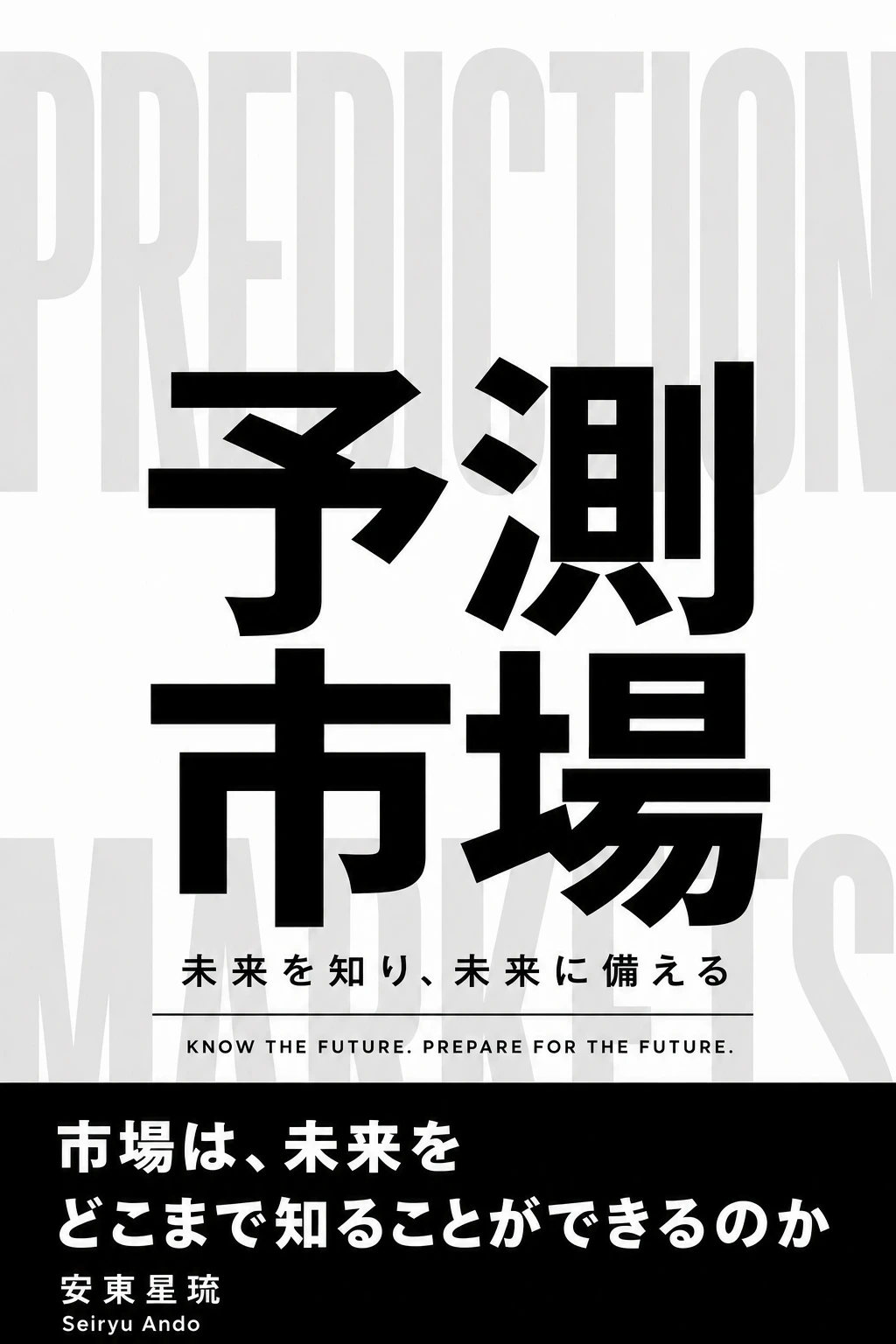
Prediction Markets: Know the Future, Prepare for the Future
Seiryu Ando (Graduate School of Economics, Kyoto University)
View on AmazonHow much of the future can a market know?
Prediction markets turn information and expectations about events that have not yet happened—elections, recessions, company sales, disasters, and policy changes—into a single market price.
But that price is not a crystal ball. It reflects not only forecasts, but also demand for hedging, attitudes toward risk, funding constraints, and liquidity. A contract priced at ¥70 does not necessarily represent an objective 70 percent probability.
This Japanese-language Kindle book approaches prediction markets as both markets for learning about the future and markets for preparing for it. Through election markets, corporate prediction markets, event contracts, AI, market makers, and regulation, it asks when forecasting and hedging reinforce each other, when they conflict, and how prediction markets might be used in Japan.
The book is now available on Amazon Kindle. View the book on Amazon.co.jp.
Contents
Introduction
Prologue: Knowing the Future, Preparing for the Future
Part I: What Are Prediction Markets?
- Chapter 1: Trading Future Events
- Chapter 2: One Contract, Two Values—Forecasting and Hedging
- Chapter 3: Does ¥70 Mean 70%?
- Chapter 4: How Do Prediction Markets Differ from Gambling, Insurance, and Derivatives?
Part II: What Can Prediction Markets Do?
- Chapter 5: What Do Prediction Markets Add to Other Forecasts?
- Chapter 6: Asking Employees About the Company’s Future
- Chapter 7: When Prices Become News
- Chapter 8: Can Event Contracts Function as Hedges? Implementation Conditions and Limits
Part III: Designing Markets
- Chapter 9: What Should Be Forecast, and How Should It Be Resolved?
- Chapter 10: Where Does Liquidity Come From?
- Chapter 11: How Can Fairness in Prediction Markets Be Protected?
Part IV: Institutionalizing Prediction Markets
- Chapter 12: The Same 65%, Different Institutions—Five Models for Quantifying the Future
- Chapter 13: Making Prediction Markets a Reality in Japan