

Sales Science — Why We Need This Field Now
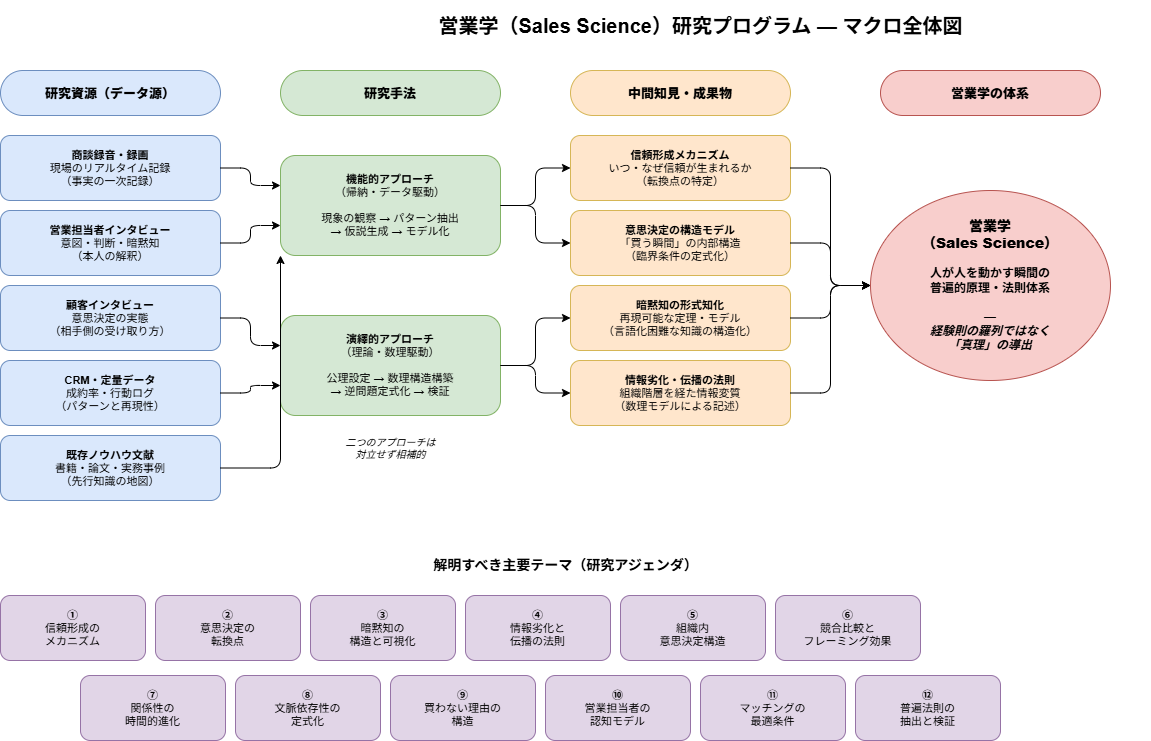
AI Reveals What Only Humans Can Do
AI is replacing many parts of sales. Data collection, document creation, market analysis, standard proposals—these are already being automated.
But AI did not take away the core of sales.
Instead, something else happened. By removing unnecessary tasks, AI has made what only humans can do more clear than ever:
- Trust between people
- Empathy that finds unspoken needs
- Intelligence that reads context and makes decisions
These are uniquely human abilities that AI cannot copy. Yet surprisingly, no academic field studies this systematically.
Why Didn't "Sales Science" Exist Before?
Sales (especially B2B) drives the world economy, yet it has never been established as an independent academic field.
| Related Field | What It Studies | Limits for Sales |
|---|---|---|
| Sales Management | Organization, process, KPI management | Doesn't study human psychology |
| B2B Marketing | Buying behavior description | Fragmented, not central |
| Behavioral Economics & Psychology | Why people buy | Not specific to sales context |
| Conversation Analysis | Structure of dialogue | Weak connection to results |
| Knowledge Management | Making tacit knowledge explicit | Not a theory specific to sales |
Each field has value, but none can explain "what happens when one person moves another person to act"—the core of sales—in a unified way.
The reasons are clear:
- Sales depends more on "people, context, relationships" than on reproducible laws
- Knowledge stayed locked inside companies as craft skills
- Academia dismissed it as "dirty practical work"
- Too many variables made it hard to establish scientific laws
But AI changed everything.
AI made it possible to transcribe and analyze large amounts of sales call data. We can now study the "word choice," "pauses," and "listening style" of top salespeople in a structured way. We finally have the tools to break through the limits of traditional qualitative research.
Foundation: Six Core Principles of Sales
We use an axiomatic method—building the entire theory from a few basic principles—to create the foundation of Sales Science.
Just as physics builds mechanics from Newton's laws of motion, Sales Science can derive rich theorems from a small number of axioms.
First Axiom: Conditions for Closing
A sale happens when Trust times Need Awareness exceeds a threshold . It happens suddenly and completely.
- (Empathy) is the only input variable the salesperson can control
- Empathy does two things at once: builds trust and makes hidden needs visible
- If either is missing, the product is nearly zero and no sale happens
This simple equation explains what salespeople have experienced for years: "We get along well but nothing sells" ( high, low), "Great proposal but no response" ( low, high)—both come naturally from the multiplication structure.
Second Axiom: How Trust Forms
Trust forms as the product of perceived Competence and perceived Benevolence .
People don't buy from "smart but untrustworthy people" ( high, low) or "nice but unreliable people" ( low, high). The same multiplication structure from the first axiom appears again inside trust itself.
Third Axiom: The Threshold Structure
The closing threshold is not fixed. It changes based on irreversibility, importance, urgency, and reversibility of the purchase. And is a variable that sales can control.
This explains why "start small" works, why SaaS is easier to sell, and why urgent situations close deals faster.
Fourth Axiom: Relationship Dynamics
Trust is a "memory variable" that accumulates and naturally decays. Need is a "state variable" that also changes independently with external environment.
Trust builds slowly and decays slowly. Needs can change suddenly with external events. This asymmetry explains why "long-term relationships suddenly produce big deals." Building trust in normal times is like buying a real option in finance.
Fifth Axiom: Competitive Context
When multiple alternatives exist, a sale depends on relative advantage and switching costs.
Price competition signals that differentiation has failed. When forced to discount, the salesperson has already lost the real battle.
Sixth Axiom: Objective Value Fit
Post-sale trust depends on objective fit between product and true need. If is insufficient, trust collapses after the sale.
This axiom defines "when not to sell." Inappropriate selling is self-destructive in the long run—not as an ethical issue, but as a mathematical result of optimization.
What the Axioms Tell Us: Key Theorems
From six axioms, we can derive rich theorems that explain sales phenomena.
Below are the most important theorems.
Bottleneck Theorem
The most efficient way to maximize is to raise the smaller variable first.
High trust without need doesn't sell. High need without trust doesn't sell. In multiplication, the lower variable is always the bottleneck. "Good relationship but no sales" and "good proposal but no response" are two sides of the same structural problem.
Hysteresis Theorem
Once a customer says "No," getting them to "Yes" requires higher than the original closing threshold .
This comes from isomorphism with cusp catastrophe theory. A lost deal means "climbing a higher wall," not "going back." This quantifies the value of not losing in the first place.
Trust Savings Theorem
Building when is low (normal times) enables closing when spikes suddenly.
Investing in customers who "don't need it now" is not wasted. Building trust in advance is like buying a real option. A need spike (external change) is the exercise timing.
Authenticity Theorem
The authenticity of needs the customer reveals depends on trust level . Need understanding at low is systematically distorted.
First meetings mostly capture "surface needs." "Lost on price" might mean you never accessed the true need.
Ethical Sales Theorem
Sales that maximize short-term profit (selling despite poor fit) is self-destructive long-term. This is not a moral issue but a result of optimization.
When long-term trust is the objective function, inappropriate sales minimize it. In tightly connected B2B networks, one bad sale destroys multiple future opportunities through reputation spread.
Grand Unified Equation
Combining six axioms produces a unified description of sales phenomena:
| Factor | Meaning | Who Controls It |
|---|---|---|
| (Competence) | "This person understands" | Salesperson skill |
| (Benevolence) | "This person acts for my benefit" | Salesperson attitude |
| (Latent Need) | Essential need from customer environment | Customer environment (external) |
| (Quality of Awareness) | Power to draw out needs | Salesperson skill |
| (Threshold) | Psychological hurdle for buying decision | Can be controlled by proposal design |
Note that the same "product-threshold structure" appears recursively at multiple levels:
This fractal self-similarity suggests Sales Science is unified by a single mathematical principle—"qualitative change happens when the product of two necessary conditions exceeds a threshold."
Connections Across Fields
The axiomatic system of Sales Science has deep structural similarities with many existing academic fields. This shows that sales sits at the intersection of human cognition, society, and economic activity.
Connection to Physics
| Physics Model | Sales Correspondence |
|---|---|
| Phase transition, critical phenomena | Discontinuous qualitative change "not buying → buying." Critical crossing of |
| Cusp catastrophe | Hysteresis in closing/losing. Mathematical basis for "can't explain why they decided" |
| Potential field | Empathy lowers barriers, need creates gradient |
| Percolation theory | When trust in organization exceeds threshold, it "percolates" to buying decision |
Connection to Psychology
| Psychology Model | Sales Correspondence |
|---|---|
| Elaboration Likelihood Model (ELM) | Low trust → judge by "who says it." High trust → "what they say" gets through |
| Theory of Mind | Cognitive basis of empathy. ToM ability determines efficiency of and |
| Prospect Theory | Loss aversion shapes risk perception. Use of framing effects |
| Signal Detection Theory | Empathy = sensitivity to detect true needs. Quantifies difference between top and average salespeople |
Connection to Economics
| Economics Model | Sales Correspondence |
|---|---|
| Information asymmetry | Customer knows their needs. Salesperson doesn't. Empathy closes the information gap |
| Signaling theory | Empathetic behavior is a costly signal of "trustworthiness" |
| Revelation principle | Theoretical basis for conversation design that makes customers honestly reveal true needs |
| Real option theory | Building trust in advance = buying options. Need spike = exercise timing |
Connection to Mathematics & Statistics
| Mathematical Model | Sales Correspondence |
|---|---|
| Hidden Markov Model (HMM) | Separating customer's hidden mental states from observable behavior. Estimate transition matrix from sales data |
| Stochastic Differential Equation (SDE) | Modeling trust evolution over time. Stochastic process with drift + noise |
| Structural Equation Modeling (SEM) | Framework to estimate unobservable , from observable variables |
| Causal Inference (Pearl DAG) | Causal graph "empathy → trust → sale." Identifying intervention effects |
These structural similarities show that Sales Science is not a standalone field but an interdisciplinary domain at the intersection of physics, psychology, economics, and mathematics.
What Each Axiom Explains
| Axiom | Questions It Answers |
|---|---|
| First Axiom | Why do the same actions produce different results? |
| Second Axiom | Why doesn't a good relationship always lead to sales? Why does one question suddenly build trust? |
| Third Axiom | Why does starting with a trial make closing easier? Why are urgent situations easier to sell in? |
| Fourth Axiom | Why do long-term relationships suddenly produce big deals? Why do relationships cool when apart? |
| Fifth Axiom | Why do we get pulled into price competition? Why are existing vendors strong? |
| Sixth Axiom | Why do honest salespeople win long-term? Why is customer success important? |
These are questions experienced daily in sales but never systematically explained before.
Research Possibilities
This axiomatic system is not just theoretical speculation. All axioms contain measurable variables and can be tested through empirical research.
| Axiom | Measurement Method | Analysis Approach | Required Data |
|---|---|---|---|
| First | SEM estimation of , | Logistic regression | Sales call recordings + CRM |
| Second | Interview ratings | Structural equations, experiments | Customer interviews |
| Third | Customer surveys | Experimental design comparison | Proposals + closing data |
| Fourth | Contact frequency time series | SDE estimation | CRM history data |
| Fifth | Estimate competitor | Churn analysis | Competitor info + lost deal data |
| Sixth | Post-implementation evaluation | Survival analysis | Customer satisfaction + retention data |
With AI now enabling large-scale transcription and structural analysis of sales calls, empirical research at unprecedented scale and precision has become realistic.
To Researchers and Practitioners
Position of This Theory
The axiomatic system shown here is not a completed theory. It is a starting point.
We publish this as the "first flag" for a theoretical framework that unifies sales phenomena.
Call to Action
Establishing Sales Science requires wisdom from many fields and feedback from practitioners.
To Researchers
- Insights from psychology, economics, mathematics, physics, sociology, linguistics—all fields can refine this theoretical system
- Countless open research questions: validating axioms, extending theorems, discovering new structural models
- We welcome collaboration, critical examination, and theoretical dialogue
To Practitioners
- Empirical research needs real sales data—recordings, CRM, customer feedback
- We seek companies and sales organizations willing to collaborate on theory validation
- We want feedback from the field on how this theory applies to practice
Our Goal
Sales is the frontline of human value that AI cannot replace.
Rather than locking that value inside individuals as "craft" or "intuition," we aim to open it as reproducible knowledge that anyone can learn, test, and develop.
That is why we envision Sales Science as an academic field.
At a seminar, a sales specialist said:
"There is no academic field for sales."
That single statement became our starting point.
There are countless how-to books on sales. But they are simply what remains after cutting away the experience and intuition—the "tacit knowledge"—that skilled salespeople have built over many years.
What if the real value lies in exactly what was cut away?
From that question, this project began. To systematize tacit knowledge. To establish sales as "reproducible knowledge." That is our goal.
Mathematical Proof Verification
Below is the verification using Lean to confirm that the theorems and axioms are mathematically correct.
The 6 Axioms (Formalized as Definitions)
| Axiom | Formula | Meaning |
|---|---|---|
| 1. Closing Condition | Sale closes when Trust Need exceeds threshold | |
| 2. Trust Mechanism | Trust = Competence Benevolence | |
| 3. Threshold Structure | Threshold varies with context | |
| 4. Relationship Dynamics | Trust accumulates and decays | |
| 5. Competitive Context | Winning requires relative advantage | |
| 6. Value Alignment | Post-sale trust depends on fit |
Bottleneck Theorem
To maximize , raise the smaller variable first.
| Theorem | Statement | Status |
|---|---|---|
bottleneck | Verified | |
bottleneck_symmetric | Verified | |
multiplier_effect_T | Verified | |
multiplier_effect_N | Verified | |
am_gm_sales | (AM-GM) | Verified |
am_gm_equality | Verified |
Trust Savings Theorem
Build in normal times → close when spikes. Isomorphic to real options.
| Theorem | Statement | Status |
|---|---|---|
trust_savings | closes | Verified |
min_trust_for_closing | closes | Verified |
Threshold Manipulation Theorems
Sales can manipulate .
| Theorem | Statement | Status |
|---|---|---|
urgency_lowers_threshold | Verified | |
reversibility_lowers_threshold | Verified | |
stakes_raise_threshold | Verified |
Hysteresis Theorem
After a lost deal, higher than the original is required to recover.
| Theorem | Statement | Status |
|---|---|---|
hysteresis_recovery_harder | closes at original also exceeded | Verified |
cost_of_losing | (cost of losing) | Verified |
Trust Properties
Trust requires both competence and benevolence.
| Theorem | Statement | Status |
|---|---|---|
trust_zero_competence | Verified | |
trust_zero_benevolence | Verified | |
trust_maximum | Verified | |
trust_nonneg | Verified | |
trust_le_one | Verified | |
trust_bottleneck | invest in first | Verified |
Authenticity Theorem
Need understanding at low trust is systematically distorted.
| Theorem | Statement | Status |
|---|---|---|
authenticity_full_trust | Verified | |
authenticity_no_trust | Verified | |
perceived_need_interpolates | (convex combination) | Verified |
higher_trust_better_perception | Verified |
Competition Theorems
Price competition is a signal of failed differentiation.
| Theorem | Statement | Status |
|---|---|---|
price_war_signal | cannot win | Verified |
incumbent_advantage | Equal + switching cost incumbent wins | Verified |
Ethical Sales Theorem
Misfit selling is self-destructive as a solution to an optimization problem.
| Theorem | Statement | Status |
|---|---|---|
poor_fit_destroys_trust | Verified | |
good_fit_builds_trust | Verified |
Dynamics Equilibrium
Equilibrium values of trust and need in steady state.
| Theorem | Statement | Status |
|---|---|---|
trust_equilibrium | Verified | |
need_equilibrium | Verified |
Grand Unification
The same "product-threshold structure" appears fractally and recursively at multiple levels.
| Theorem | Statement | Status |
|---|---|---|
grand_unification_direct | Grand Unified Score | Verified |
three_level_expansion | closes | Verified |
compositional_closing | Sub-activations compose into global closing | Verified |
recursive_bottleneck | Bottleneck theorem applies recursively at all levels | Verified |
scale_invariance | Market growth preserves activation structure | Verified |
Verification Environment
| Item | Value |
|---|---|
| Theorem Prover | Lean 4 (v4.29.0) |
| Math Library | Mathlib 4 (leanprover-community) |
| Total Build Jobs | 4,320 |
| Total Theorems | ~50 |
| Sorry-free | 49/50 (1 sorry in TAP Theorem 3 rpow identity) |
| Sales Science | All sorry-free |